
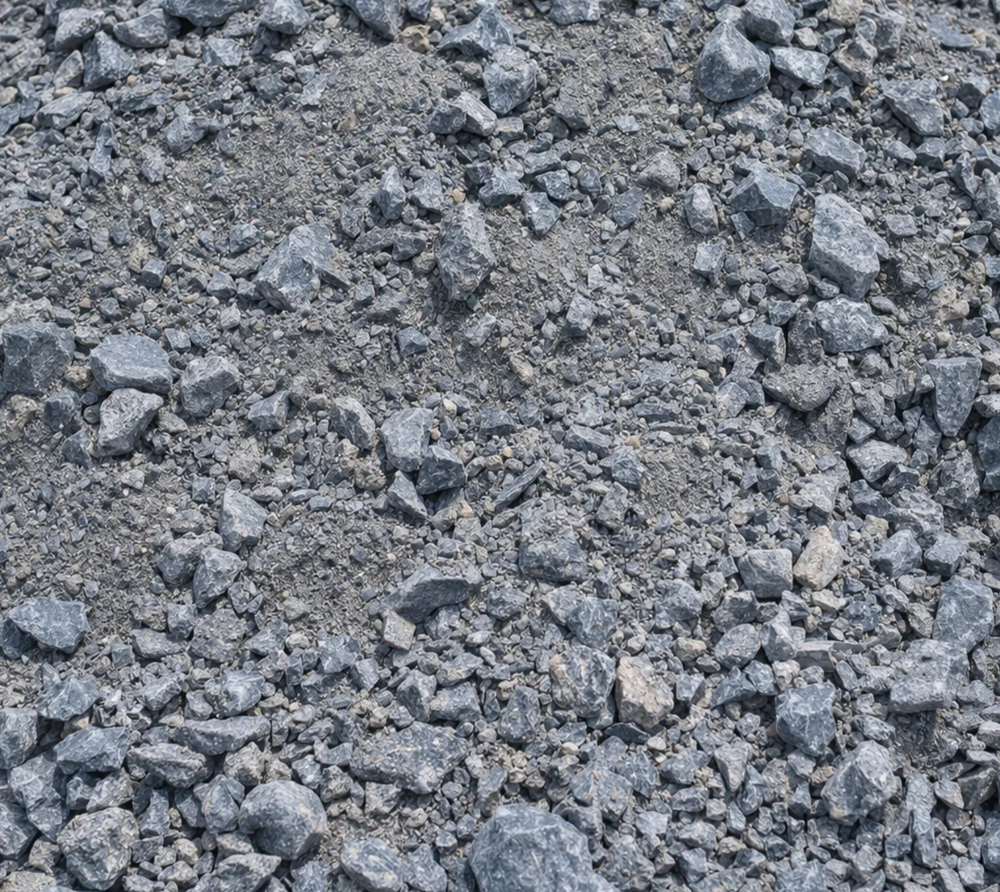
3/4 gravel is one of the most-asked-for materials at any landscape supply yard, and one of the most-misordered. The reason: "3/4 gravel" is not a single product. It is two products with a similar name and very different uses. 3/4 minus compacts hard for driveways, road base, and shed pads. 3/4 clean stays loose and free-draining for French drains, retaining-wall backfill, and dry wells. Get the wrong one and the project either washes out (clean where minus belongs) or floods (minus where clean belongs).
This guide walks through the difference, the four 3/4 products we stock at Harbor Soils with current per-yard pricing, the right use case for each, and how to calculate and install. Pacific Northwest sites have their own quirks (clay layers, winter rain, slope drainage) and we cover those too.
What is 3/4 gravel? 3/4 minus vs 3/4 clean
3/4 gravel is crushed rock 3/4 inch and smaller. It comes in two grades that look similar in a stockpile but do opposite jobs.
3/4 minus (with the fines included) compacts hard. Use it for driveways, road base, shed pads, paver bases. $34.99/yard at Harbor Soils.
3/4 clean (with the fines screened out) drains freely. Use it for French drains, behind retaining walls, dry wells. $43.99/yard at Harbor Soils.
Get them mixed up and the project either washes out (clean where minus belongs) or floods (minus where clean belongs). The grades are not interchangeable.
3/4 minus vs 3/4 clean: what's the difference?
If you remember nothing else from this page, remember this:
- Minus = compacts. Has the dust and fines. Use it under loads (driveways, pads, paths).
- Clean = drains. Has no fines. Use it around water (drains, backfill, dry wells).
Most failures in residential rock work come from using clean where minus belongs (driveway shifts and pots up) or minus where clean belongs (French drain silts up in 18 months, retaining wall fails from hydrostatic pressure). The grades are not interchangeable even though they look similar in a stockpile.
There is one common situation where you use both on the same project: a driveway with a French drain underneath. Pipe + clean rock + fabric on the bottom (drain), minus on top (driving surface). Layer them in that order and you get a driveway that drains for decades.
3/4 gravel products at Harbor Soils
We stock four 3/4 products: standard minus, premium minus ("Harbor Blue"), standard clean, premium clean. The Harbor Blue variants are sourced from a specific Pacific Northwest quarry that produces a blue-gray basalt with consistent color and unusually clean fracturing. They cost more, but for projects where the rock will be visible (drainage channels in a landscaped yard, decorative French drains, chip topcoats on a finished driveway) the appearance upgrade is significant.
3/4 Minus — $34.99/yard
3/4 Minus is the workhorse driveway base material in our region. Crushed rock 3/4 inch and down, with all the fines included. Compacts hard, holds shape under traffic, drains adequately for residential surfaces. Spread 3-4 inches over compacted native soil or pit run base, compact in 2-inch lifts.
3/4 Minus Harbor Blue — $44.99/yard
3/4 Minus Harbor Blue is the same product in premium blue-gray basalt. Same compaction behavior, same depth specs, more attractive appearance. Use when the driveway or surface will be visible from the house or street and you want a more uniform finished look than standard minus delivers.
3/4 Clean — $43.99/yard
3/4 Clean is the standard French drain rock in the Pacific Northwest. 3/4 inch crushed rock with all fines screened out. Stays loose, drains freely, surrounds perforated pipe properly without packing in around it. This is what most engineers and drainage contractors spec for residential drainage work in our region.
3/4 Clean Harbor Blue — $54.99/yard
3/4 Clean Harbor Blue is premium clean rock in the same blue-gray basalt. Same drainage performance. Choose when the drainage layer will be visible (open swales, dry creek beds with drainage function, decorative drainage channels).
3/4 Chip — $44.99/yard
3/4 Chip is a different beast. The rock is more uniform in size and shape than minus or clean, with a chip-cut profile that gives a cleaner decorative finish. Use it as a topcoat on a finished driveway, as a decorative ground cover in low-traffic areas, around the base of trees and shrubs, or as a low-cost alternative to crushed decorative rock. Not for structural use; it does not compact and does not drain in the way clean does. If you want a rounded, barefoot-friendly surface for paths and patios instead of a chip-cut one, see our pea gravel guide.
Browse the full crushed rock collection.
When to use 3/4 minus
Residential driveway base
The default driveway buildup over Kitsap-area native soils is 4 to 6 inches of compacted 3/4 minus, in 2-inch lifts, optionally with a 4-inch Pit Run ($16.99/yard) base layer on long drives or wet sites. See our gravel driveway installation guide for the full procedure including geotextile fabric placement and compaction specs.
Road base for private roads
For private access roads, longer driveways, and any surface that needs to handle occasional heavy vehicles (delivery trucks, RVs, construction equipment), 3/4 minus is the standard road base. Build 6 inches over compacted pit run on most sites; 8 inches if soils are wet or the road will see truck traffic.
Shed pads and outbuilding foundations
A 4-inch compacted layer of 3/4 minus under a 10x12 ft shed footprint gives you a level, drained, settling-resistant base that beats poured concrete on cost and on most performance measures. Excavate 6 inches of native soil first, then compact in two 2-inch lifts.
3/4 gravel for paver bases
For sand-set pavers, the standard base is 4 to 6 inches of compacted 3/4 minus or 5/8 minus, in 2-inch lifts, with 1 inch of bedding sand on top. See our paver base gravel guide for the size-by-application details. 3/4 minus is preferred for thicker bases under heavier-load pavers (vehicle parking, fire pit areas, outdoor kitchens with heavy stone). For pedestrian patios, 5/8 minus gives a slightly smoother base, but 3/4 minus works fine and holds up better on wet sites.
Pathways and access trails
Compacted 3/4 minus makes a durable garden pathway that handles wheelbarrow traffic without rutting. Spread 3 inches over excavated native soil, compact, optionally edge with rockery or timber.
When to use 3/4 clean
French drains
The standard French drain in Western Washington uses 4-inch perforated pipe wrapped in non-woven geotextile fabric, surrounded by 3/4 clean rock. The clean rock surrounds the pipe with void space for water to enter; the fabric stops fine soil from migrating into the system. See our French drain installation guide for trench depth, slope, and pipe orientation.
Behind retaining walls
Any retaining wall over 2 feet needs free-draining backfill behind it. Use 3/4 clean (or 1-1/2 clean for larger walls). Hydrostatic pressure from soggy backfill is the most common cause of retaining-wall failure in our wet climate. The drainage backfill plus a perforated pipe at the base of the wall lets water escape rather than push the wall over.
Dry wells
A dry well is a buried gravel-filled pit that catches roof runoff or surface drainage and lets it infiltrate into the soil over hours instead of seconds. 3/4 clean (or 1-1/2 clean for large wells) gives you 30 to 40 percent void space, so a 5-foot-diameter, 6-foot-deep well holds roughly 350 gallons of water. Wrap with fabric on all sides to prevent the surrounding soil from clogging the system.
Drainage layers under hardscape
On wet sites where a paver patio or outdoor living surface needs a drainage layer below the structural base, 6 inches of 3/4 clean over fabric, then the structural minus base on top, gives water somewhere to go. This is increasingly common on Bainbridge and the Hood Canal benches where clay soils sit close to the surface.
Underground pipe bedding
Any utility pipe (water service, irrigation main, drain line) gets bedded and surrounded with 3/4 clean. The clean rock protects the pipe from point loading, drains away water that would otherwise pool around it, and gives you a stable trench bottom.
How much 3/4 gravel do you need?
Formula: Length (ft) × Width (ft) × Depth (in) ÷ 324 = Cubic yards needed
For minus applications, add 10 to 15 percent for compaction loss (the fines settle into the void space as you compact). For clean applications, add 5 percent for placement waste; clean rock does not compact and the calculation is closer to the literal volume.
| Project | Product | Area | Depth | Yards needed |
|---|---|---|---|---|
| Driveway resurfacing | 3/4 minus | 1,000 sq ft | 3 in | ~10 yards |
| New driveway base | 3/4 minus | 1,200 sq ft (100×12) | 5 in | ~21 yards |
| Shed pad | 3/4 minus | 120 sq ft (10×12) | 4 in | ~1.7 yards |
| French drain | 3/4 clean | 50 ft × 1 ft trench | 18 in (excl. pipe) | ~3 yards |
| Retaining wall backfill | 3/4 clean | 40 ft × 1 ft thick | 4 ft tall | ~6 yards |
| Dry well | 3/4 clean | 5 ft diameter | 6 ft deep | ~4.4 yards |
| Paver patio (minus base + sand bedding) | 3/4 minus | 200 sq ft | 4 in | ~3 yards |
For complex projects with multiple grades and depths, use our Landscape Material Calculator.
How to install 3/4 minus
Minus needs compaction to perform. The compaction is what locks the fines into the voids and gives you a hard, stable surface.
- Excavate. Remove topsoil, sod, and any soft organic material. For a driveway, excavate 6 to 8 inches below finished grade. For a shed pad, 6 inches. For a path, 4 inches.
- Lay fabric. Non-woven geotextile fabric on the excavated subgrade. Stops the underlying soil from migrating into your gravel layer over years. Skipping this saves an hour now and costs you a re-grade in 5 years.
- Spread in 2-inch lifts. Do not dump and spread a 4-inch layer in one shot. Spread 2 inches, compact, spread the next 2 inches, compact again. Compacting deeper than 2 inches per lift leaves voids that show up later as low spots.
- Compact with a plate compactor. Rent one from a local equipment yard ($60-$80/day). Hand tampers do not generate enough force on minus. For a driveway, run the plate compactor in overlapping passes, both directions.
- Crown the surface. For driveways, finished grade should be 1 to 2 inches higher in the center than at the edges. This is what sheds rain off the surface and away from the structural base. A flat driveway puddles.
How to install 3/4 clean
Clean does not get compacted. Trying to compact clean either does nothing (the rock just shifts) or crushes the rock into fines, which defeats the entire purpose.
- Excavate. Trench depth depends on application. For a French drain, 18 to 24 inches below finished grade. For dry well, 5 to 8 feet. For retaining wall backfill, behind and below the wall down to the footing.
- Lay fabric. Non-woven geotextile lining the entire trench or pit. Critical: clean rock without fabric is a soil-migration disaster waiting to happen. Soil works its way into the void space and the drainage stops working in 18 to 36 months.
- Place pipe (if applicable). Perforated pipe goes on a 2-inch base layer of clean rock, with the perforations facing DOWN (this is counterintuitive but correct; the water table rises into the pipe from below).
- Fill with clean rock. Dump or shovel in. No compaction. The natural angle of repose holds the rock in place. For deep fills, work in 12-inch increments to settle the rock evenly.
- Wrap fabric over the top. Fold the trench-lining fabric over the top of the rock to fully enclose. Cover with 4 to 6 inches of native soil and topsoil, then plant or sod over.
3/4 gravel cost per project
| Project | Product | Yards | Material cost |
|---|---|---|---|
| Driveway resurfacing (1,000 sq ft, 3") | 3/4 Minus | 10 yds | ~$350 |
| New driveway (1,200 sq ft, 5") | 3/4 Minus | 21 yds | ~$735 |
| Same, Harbor Blue upgrade | 3/4 Minus Harbor Blue | 21 yds | ~$945 |
| 50 ft French drain (18" trench) | 3/4 Clean | 3 yds | ~$132 |
| Behind 40 ft × 4 ft retaining wall | 3/4 Clean | 6 yds | ~$264 |
| Dry well (5' × 6') | 3/4 Clean | 4.4 yds | ~$194 |
| Shed pad (10x12 ft, 4") | 3/4 Minus | 1.7 yds | ~$60 |
Delivery fees are added based on distance from our Gig Harbor yard at 11612 WA-302. 3/4 gravel runs roughly 1.4 to 1.5 tons per yard, so trucks max out faster on rock than on lighter materials like bark or compost. Large orders (10+ yards) often need multiple loads; we coordinate.
3/4 vs 5/8 vs 1-1/2 minus: which size do I want?
All three are common driveway-base grades; they perform differently on different sites.
- 5/8 minus is the most popular residential driveway grade in our region. Smaller top size compacts to a smoother finished surface. Use for standard residential drives with moderate traffic. See our 5/8 minus guide.
- 3/4 minus is slightly larger top size, slightly rougher finished surface, but harder-wearing under traffic. Use for longer drives, drives with RV or boat trailer storage, and any surface that sees heavier loads.
- 1-1/4 minus is for heavy-duty surfaces: agricultural access, construction-site grade work, large commercial drives. 1-1/4 minus is $35.99/yard. Rougher finish than 5/8 or 3/4, but holds up to heavy trucks.
If you are unsure, default to 5/8 for car-only residential drives and 3/4 for anything that will see heavier vehicles or longer service life. Going the other direction, for walking paths and flagstone leveling there is a finer grade below 5/8: see our 1/4 minus (quarter minus) guide.
Delivery and access
We deliver 3/4 gravel throughout Gig Harbor, Port Orchard, Bremerton, Silverdale, Poulsbo, Bainbridge Island, Olalla, Purdy, Fox Island, and Key Peninsula. Most weekday orders deliver same-day or next-day. For driveway projects over 15 yards, we plan multiple loads and coordinate timing so the driveway doesn't choke on a single dump pile.
Truck access requirements: driveway or paved-area drop is standard. We do not drive on lawn or wet ground. For back-yard or hard-access sites, we drop on the driveway and you wheelbarrow or skid-steer to the work area. Tell us about steep, narrow, or soft access points when you order.
Order online at harborsoils.com/collections/crushed-rocks or call 253-857-5125 for project-specific quoting.
Harbor Soils
11612 WA-302, Gig Harbor, WA 98329
253-857-5125 · [email protected]
Frequently asked questions
What is 3/4 gravel?
3/4 gravel is crushed rock sized 3/4 inch and smaller. It comes in two grades: 3/4 minus (with the fines included, compacts hard) and 3/4 clean (with the fines screened out, stays loose and drains). Both are common Pacific Northwest landscape materials; minus for driveways and structural bases, clean for drainage applications.
What is the difference between 3/4 minus and 3/4 clean?
3/4 minus contains rock plus all the dust and fines from crushing; the fines lock together and compact under traffic. 3/4 clean has the fines screened out; it stays loose and free-draining. Use minus where you need a hard compacted surface (driveways, pads). Use clean where you need water to drain through the rock (French drains, behind retaining walls, dry wells).
How much does 3/4 gravel cost per yard in Gig Harbor?
At Harbor Soils, 3/4 minus is $34.99/yard, 3/4 minus Harbor Blue (premium) is $44.99/yard, 3/4 clean is $43.99/yard, and 3/4 clean Harbor Blue is $54.99/yard. 3/4 chip (decorative) is $44.99/yard. Delivery fees are based on distance from our Gig Harbor yard.
How much 3/4 gravel do I need for my driveway?
Multiply length by width by depth (in feet) and divide by 27. For a 100 ft × 12 ft driveway at 4 inches deep: 100 × 12 × 0.33 ÷ 27 = 14.7 yards. Order 10 to 15 percent extra for compaction loss. For most residential drives, 4 to 5 inches of compacted 3/4 minus is the right depth.
What is Harbor Blue gravel?
Harbor Blue is a premium blue-gray basalt sourced from a specific Pacific Northwest quarry. It has more consistent color and cleaner fracturing than standard gray crushed rock. We stock both 3/4 minus Harbor Blue ($44.99/yard) and 3/4 clean Harbor Blue ($54.99/yard). Use it for projects where the rock will be visible and you want a more uniform finished appearance.
Can I use 3/4 clean for my driveway?
No. 3/4 clean does not compact, so a driveway built on it will shift, rut, and develop low spots within months. Use 3/4 minus (or 5/8 minus) for the driving surface. If your driveway has a drainage problem, the right solution is a French drain underneath the driveway, not switching the surface gravel to clean.
Can I use 3/4 minus for a French drain?
No, and this is the most common failure mode in DIY drainage work. Minus has fines, the fines pack around the perforated pipe and clog the drainage holes, and within a year or two the drain stops working. Use 3/4 clean for any French drain. The cost difference ($34.99 vs $43.99 per yard) is trivial compared to re-digging a failed drain.
What size gravel is best for a driveway base?
5/8 minus and 3/4 minus are both standard residential driveway bases. 5/8 compacts to a smoother surface; 3/4 holds up better under heavier loads (RVs, boat trailers, regular truck traffic). For most car-only drives, 5/8 is the default. For long drives or anything heavy, 3/4. For commercial or agricultural surfaces, 1-1/4 minus.
Do I need fabric under 3/4 gravel?
Yes, in nearly every application. Non-woven geotextile fabric between the native subgrade and the gravel layer stops soil from migrating up into the rock voids over time. Without fabric, even a perfectly installed driveway base will develop soft spots within 5 years as soil works its way up through the rock. Fabric is cheap insurance against a re-grade.
Can 3/4 gravel be delivered to Bainbridge Island and Bremerton?
Yes. We deliver 3/4 minus, 3/4 clean, and all other crushed-rock grades throughout Gig Harbor, Port Orchard, Bremerton, Silverdale, Poulsbo, Bainbridge Island, Olalla, Purdy, Fox Island, and Key Peninsula. Bainbridge and north-Kitsap deliveries take longer than south-peninsula and the delivery fee reflects the distance from our Gig Harbor yard.