
How much does a yard of 5/8 minus weigh?
One cubic yard of 5/8 minus gravel weighs 2,700 to 2,800 pounds (about 1.35 to 1.4 tons). The exact weight varies slightly with moisture content and source quarry, but those numbers are the standard for delivery planning and truck-payload math.
That's more than most half-ton pickups can legally carry — plan on delivery or a 3/4-ton truck for one full yard or more.
We sell more 5/8 minus than almost any other product in the yard. Contractors order it by the truckload. Homeowners show up on Saturday mornings asking for "that gravel stuff that packs down hard." It's the workhorse of crushed rock, and once you understand what it does, you'll see why.
Quick answer: 5/8 minus is crushed rock screened to 5/8 inch and smaller, with all the fine particles (the "minus") included. The fines fill gaps between larger pieces during compaction, creating a hard, semi-permanent surface ideal for driveways, paths, and base layers. One cubic yard weighs approximately 2,700 to 2,800 pounds. Coverage at 4 inches deep: roughly 80 square feet per yard. Bulk price at Harbor Soils' Gig Harbor yard runs $34.99 per cubic yard, delivered or picked up.
How much does a yard of 5/8 minus weigh?
One cubic yard of 5/8 minus gravel weighs approximately 2,700 to 2,800 pounds, or about 1.35 to 1.4 tons. The exact weight varies slightly with moisture content and the source quarry, but those numbers are the standard for delivery planning and truck-payload math.
| Quantity | Approximate weight | Use case |
|---|---|---|
| 1 cubic yard | 2,700-2,800 lbs (1.35-1.4 tons) | One full pickup load if your truck is rated for it |
| 5 cubic yards | ~13,500-14,000 lbs (~7 tons) | Typical residential driveway repair or top-off |
| 10 cubic yards | ~27,000-28,000 lbs (~14 tons) | New driveway install, 10 ft × 50 ft at 6 inches |
| Half-ton pickup capacity | 1,000-1,500 lbs | About 0.4-0.5 yards, NOT a full yard |
For DIYers: a half-ton pickup is named for its cargo capacity, not for what it weighs. A full yard of 5/8 minus is over 2,500 pounds, which exceeds most half-ton ratings. Either make multiple trips, borrow a three-quarter ton, or have it delivered. Overloading a half-ton risks suspension damage and is illegal on public roads.
What is 5/8 minus gravel?
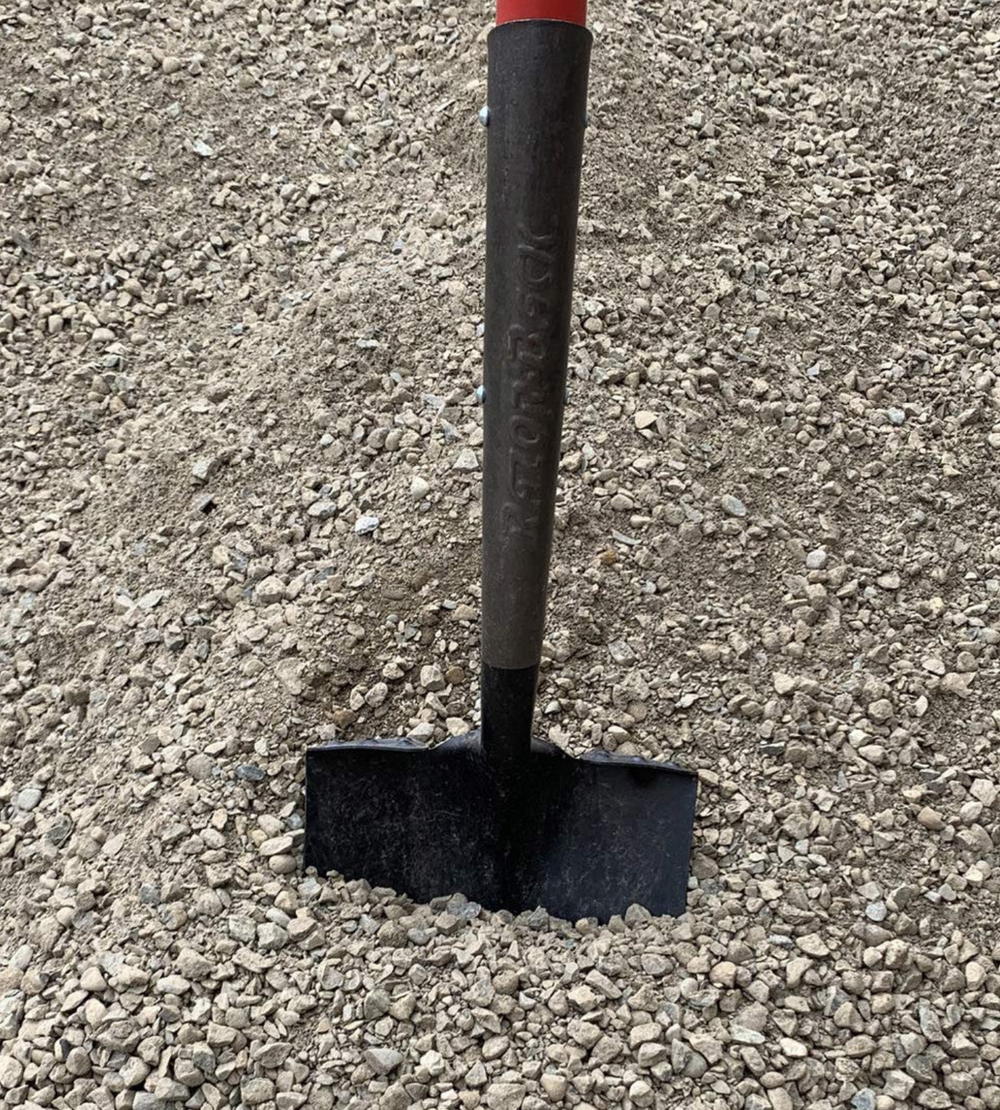
Take a piece of rock and crush it. Screen out everything bigger than 5/8 of an inch (roughly the size of a nickel). Keep all the smaller pieces and the dust that comes with crushing. That's 5/8 minus.
The "minus" part is what matters. It means the product includes everything from the 5/8-inch chunks all the way down to fine powder. When you spread it and run a compactor over it, those fines fill every gap between the larger pieces. The whole thing locks together into a surface that's almost as hard as concrete.
Compare that to "clean" gravel, where the fines have been washed out. Clean gravel stays loose. It's great for drainage because water flows right through the gaps. Terrible for a driveway because your tires just push it around. Two completely different products for completely different jobs.
5/8 minus vs 5/8 clean gravel: the difference that matters
If you've shopped around for crushed rock, you've probably seen both terms. They're the same starting product (5/8 inch crushed rock) with one critical difference: "minus" includes the fine material, "clean" has been washed to remove it. That single difference changes everything about how each product behaves.
| Property | 5/8 Minus | 5/8 Clean |
|---|---|---|
| Contains fines (dust + small particles)? | Yes | No, washed out |
| Compacts into a firm surface? | Yes, very firm with proper compaction | No, stays loose |
| Water flows through it? | Limited, fines block flow | Yes, excellent drainage |
| Best for | Driveways, paths, base layers, mud control | French drains, pipe bedding, dry creek beds |
The simple rule: if it needs to be solid, use a "minus" product. If it needs to drain, use "clean." Ordering the wrong one is one of the most common rural-property mistakes, and the consequences show up within a season.
What People Use It For
Driveways: is 5/8 minus good for a driveway?
Yes. 5/8 minus is one of the most popular residential driveway materials in Western Washington, and the workhorse of our yard. The fines pack down hard under traffic, the larger pieces provide grip, and the surface sheds water when properly crowned. A 4 to 6 inch layer of 5/8 minus, graded with a slight crown and compacted, makes a driveway that handles daily traffic for years before it needs a fresh top layer.
Where 5/8 minus is not the right pick for a driveway:
- Logging or commercial-truck routes: use 3/4 minus or 1-1/4 minus instead. Coarser material holds up under heavier loads.
- Heavy clay subgrade without a base layer: install 4 inches of 3/4 minus first as a base, then 4 inches of 5/8 minus on top for the wearing surface.
- Steep slopes (over 15% grade): gravel migrates downhill under heavy rain. Consider chip-and-seal or pavers for steep driveways.
For typical Kitsap County and Gig Harbor properties on flat-to-moderate grade, 5/8 minus is the right call for a residential driveway. Paving isn't practical or in the budget for most rural lots, and a properly installed and maintained gravel driveway can rival a paved surface for usability at a fraction of the cost.
Paths and Walkways
Compacted 5/8 minus gives you a firm surface to walk on without the cost of pavers or concrete. Side yard access, garden paths, the route from the house to the shop. It won't be as smooth as a paved surface, but it won't turn to mud either.
Base Layer
Before you set pavers, pour a concrete pad, or build a retaining wall, you need something solid underneath. 5/8 minus (or 3/4 minus for heavier loads) compacts into a base that distributes weight evenly and doesn't settle the way soil does. Skip the base layer and your patio will be wavy within two years. We've seen it happen.
Mud Control
If you live in Western Washington, you know what happens to bare ground between October and May. Three or four inches of 5/8 minus over landscape fabric turns a muddy gate area, dog run, or parking spot into something you can actually walk on without losing a boot. One of the most satisfying projects you can do on a rural property.
Backfill
Around foundations, behind retaining walls, in utility trenches. 5/8 minus compacts around pipes and irregular shapes without the large rocks that could cause damage. It doesn't expand and contract with moisture like soil does, which makes it more stable for structural applications.
How It Compares to Other Products
| Product | Has Fines? | Compacts? | Use It For |
|---|---|---|---|
| 5/8" Minus | Yes | Yes, very firm | Driveways, paths, base layers, backfill |
| 3/4" Minus | Yes | Yes, strong | Road base, heavy-duty driveways, under slabs |
| 3/4" Clean | No, washed out | No, stays loose | French drains, pipe bedding, drainage |
| Pea Gravel | No | No, shifts underfoot | Decorative areas, play areas, garden paths |
| 1/4" Minus | Yes | Yes, very smooth | Paver base, fine grading, leveling |
Simple rule: if it needs to be solid, use a "minus" product. If it needs to drain, use "clean." If it needs to look pretty, use something rounded like pea gravel or river rock. And if the job is a walking path or a flagstone setting bed rather than a driveway, step down a size: our 1/4 minus (quarter minus) guide covers the finest finish layer we sell.
How Much You Need
5/8 minus is sold by the cubic yard. One cubic yard weighs about 2,700 to 2,800 pounds (roughly 1.4 tons). A full-size pickup can safely carry about one yard, maybe one and a half if your truck has the payload rating for it.
Coverage depends on how thick you're going:
| Depth | Coverage per Yard | When to Use This Depth |
|---|---|---|
| 2 inches | ~160 sq ft | Topping off an existing surface, light paths |
| 4 inches | ~80 sq ft | Standard driveways and walkways |
| 6 inches | ~54 sq ft | Heavy traffic areas, new driveway on soft ground |
So a typical single-car driveway, 10 feet wide by 50 feet long, at 4 inches deep: that's about 6 to 7 cubic yards. Use our cubic yard calculator if you want the exact number.
How to Install It Right
You don't just dump it and call it done. There are three steps, and the third one is the one people skip (and then wonder why their gravel driveway turned into a mess).
Step 1: Prep the ground. Strip off the topsoil and vegetation. You want firm, stable dirt underneath. For a driveway, dig down 4 to 6 inches below where you want the finished surface to be.
Step 2: Spread it evenly. Use a landscape rake for smaller areas or a skid steer with a bucket for anything bigger than a few yards. If you're doing a driveway, crown it slightly in the center so rainwater runs to the edges instead of pooling.
Step 3: Compact it. This is the step that makes 5/8 minus work. Rent a plate compactor (any equipment rental place has them) and make three or four passes over the whole surface. Wet the material lightly before you start. The moisture helps the fines bind together. You'll feel the difference underfoot when it's done. It should be hard, not squishy.
Skip the compaction and you just have a pile of loose gravel that ruts every time you drive on it. Do the compaction and you have a surface that lasts.
Questions We Get a Lot
Can I use 5/8 minus for drainage?
No. The whole point of 5/8 minus is that it compacts, which means water doesn't flow through it well. For drainage, you want 3/4 clean or 7/8 drain rock. The fines in minus gravel will clog a French drain. We have a French drain guide if you're working on drainage.
Is it the same as road gravel?
Close but not identical. Road base is usually 3/4 minus or 1-1/4 minus, which is coarser and holds up better under heavy trucks. 5/8 minus gives a smoother finish and works great for passenger vehicles and foot traffic. For a logging road or heavy equipment access, go with the bigger stuff.
How heavy is a cubic yard?
About 2,700 to 2,800 pounds. That's nearly a ton and a half. Know your truck's payload rating before you load up. Most half-ton pickups max out around one yard.
Will it get muddy in the rain?
Not if you compact it properly. A well-compacted 5/8 minus surface sheds water and stays firm through the worst of our Western Washington winters. If you skip the compacting, you'll get some surface dust mixing with rain. That's on you, not the product.
Get 5/8 Minus
We keep 5/8 minus aggregate stocked at our Gig Harbor yard. Pickup or delivery across Kitsap County and Gig Harbor. Whether you need two yards for a walkway or twenty for a driveway project, call 253-857-5125 and we'll get you set up.