
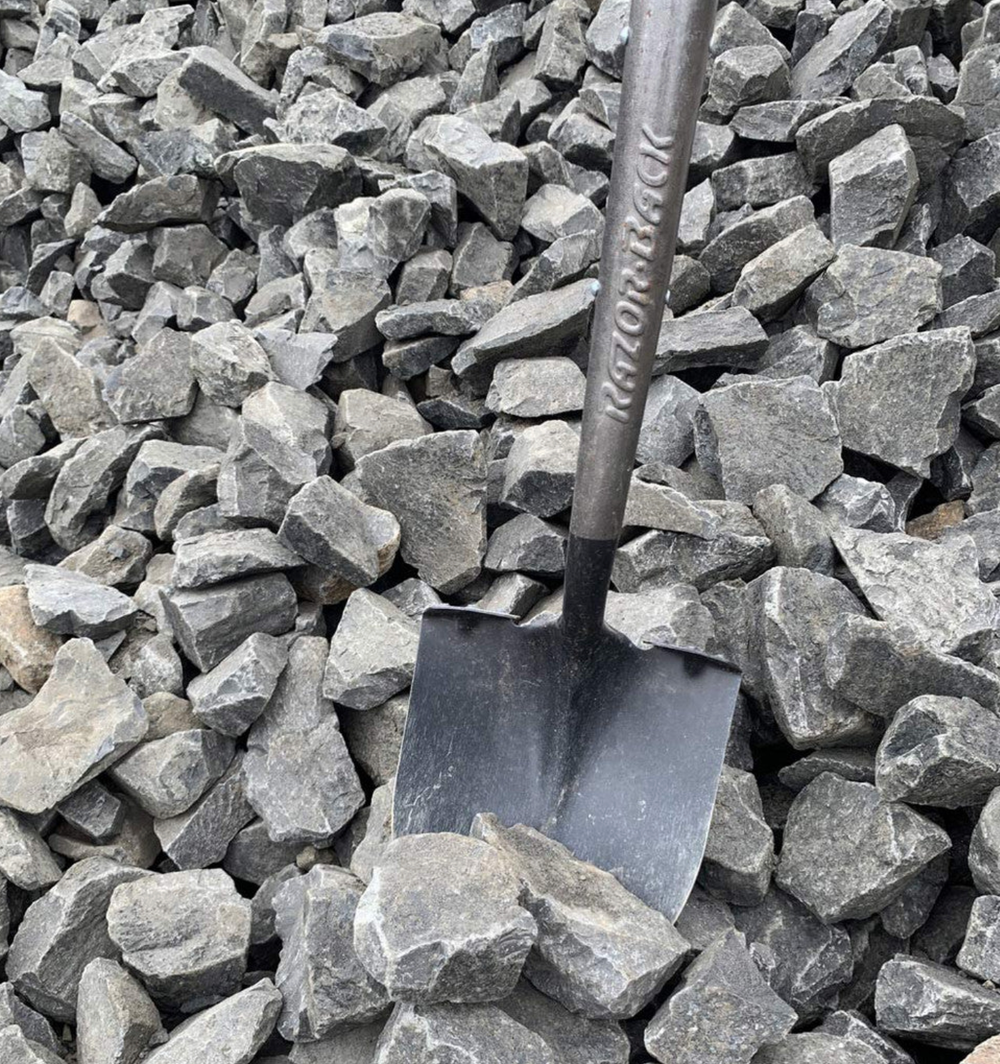
Rip rap and quarry spalls are the rough, angular, large rock you use when you need to stop water from moving earth, hold a slope from sliding, or armor a shoreline against wave action. Unlike rockery (which is selected for appearance and stacking) or driveway gravel (which is selected to compact), rip rap is selected for size, angularity, and durability. You dump it in place, sometimes place it by machine, and let its weight and interlocking shape do the work.
This guide covers what rip rap and quarry spalls are, the size classes, the real Pacific Northwest applications (shoreline armoring, slope toes, drainage channels, French-drain alternatives), real Harbor Soils delivered pricing, and how to install it for it to actually last.
What are quarry spalls? What is rip rap?
Quarry spalls are angular crushed rock 2 to 4 inches across, sold as the small-grade erosion-control rock. Used behind retaining walls, at slope toes, in gabion baskets, and as the base layer under stacked rockery on wet sites. $35.99/yard at Harbor Soils.
Rip rap is the larger grade of the same material family, typically 4 to 12 inches across. Used for stream-bank armoring, slope protection, drainage channels, and shoreline edges. 4x8 rock $34.99/yard at Harbor Soils.
Same rock family, different size grade. Spalls are the small end (2-4"), rip rap is the medium grade (4-12"), heavy rip rap is special order (12-24"+). All installed over non-woven geotextile fabric, held in place by weight and angular interlock.
Rip rap vs quarry spalls vs riprap rock: what is the difference?
These terms get used interchangeably, which is confusing because they refer to different size classes of the same material family.
- Quarry spalls are the smallest end, typically 2 to 4 inches across. They are the angular byproduct of a quarry's primary crushing operation. Used for drainage layers, behind retaining walls, slope toes, and gabion baskets on smaller projects.
- Rip rap (sometimes written "riprap" or "rip-rap") is the larger general-purpose grade, typically 4 to 12 inches across. Used for stream-bank armoring, slope protection, drainage channels, and shoreline edges where wave energy is moderate.
- Heavy rip rap (sometimes called "Class III" or specified by individual stone size) runs 12 to 24 inches or larger. Used for high-energy shorelines, jetties, and large-scale erosion control. Available by special order.
Civil and DOT specs use formal classes ("Class A," "Class III," "1-man rip rap"), but for residential and small-commercial work in our region the working vocabulary is: spalls (small), rip rap (medium), heavy rip rap (large). When you call, tell us the application and we will steer you to the right size; that is more useful than memorizing class numbers.
What we deliver and what it costs
2-4 Inch Quarry Spalls — $35.99/yard
Quarry spalls are the workhorse small-rip-rap for residential and small-commercial projects. Angular rock from a quarry's primary crushing, 2 to 4 inches across, with no fines. Used behind retaining walls (drainage backfill alternative to clean crushed rock), at slope toes, in gabion baskets, and as the base layer under stacked rockery walls in waterlogged sites.
4x8 Rock (Rip Rap Grade) — $34.99/yard
4x8 Rock is our standard rip rap grade. 4 to 8 inches across, angular, durable. The right product for stream-bank armoring, drainage swale armoring, eroding slopes, the toe of a retaining wall on a wet site, French drain alternatives where you want longer service life than gravel offers, and decorative dry creek beds in larger landscapes.
1-1/2 Inch Clean Crushed Rock — $35.99/yard
Technically not rip rap, but worth mentioning here because it is often the right choice when "small rip rap" was specified. 1-1/2 inch clean is screened (no fines), drains freely, and works as a smaller-grade armoring or drainage layer behind walls where 4x8 would be too coarse.
Larger rip rap (12-24 inch and up) — special order
For waterfront armoring, shoreline jetty work, or any project specifying individual stones over 12 inches, we coordinate special-order delivery from quarry partners. Pricing depends on stone size, source, and load. Call 253-857-5125 with your project specs (size class, total tonnage, delivery site) and we will quote.
Browse the full crushed rock collection.
When to use rip rap vs other rock
The right choice depends on whether the rock has to look good, drain, compact, or just stay put under force.
| Application | Best product | Why |
|---|---|---|
| Stream-bank erosion | 4x8 Rock | Angular shape locks together against flow; weight resists scour |
| Toe of an eroding slope | 4x8 Rock + spalls bench | 4x8 at base, spalls behind, holds soil until vegetation establishes |
| Drainage swale lining | 2-4 Inch Quarry Spalls | Stays put under runoff; lets water pass through without clogging |
| French drain alternative (long-life) | Quarry spalls in fabric burrito | Larger void space than 3/4 clean; less likely to silt up over time |
| Behind a retaining wall | 3/4 Clean or 1-1/2 Clean | Cleaner drainage profile than spalls; specified by most engineers |
| Gabion baskets | 4x8 Rock or spalls | Must be larger than basket mesh openings; angular shape locks |
| Shoreline armoring (low energy) | 4x8 Rock | Sized for moderate wave action; works for protected coves |
| Shoreline armoring (high energy) | Heavy rip rap, 12-24"+ special order | Larger stone needed to resist storm waves; permits required |
Rip rap vs rockery: which do you need?
People often think rip rap and rockery are interchangeable. They are not.
Rockery is selected for appearance, sorted for stackability, and built up as a dry-stacked retaining wall. You can see it from the house. It costs $83.99 to $107.99 per ton. See our rockery walls guide for the full breakdown.
Rip rap is selected for angularity and size, dumped or machine-placed in a layer, and lives where it can do its job without being looked at every day. It costs $34.99 to $35.99 per yard, roughly half of rockery on a dollars-per-pound basis.
If a homeowner is going to see it from the deck, use rockery. If it lives at the bottom of a creek bed, behind a slope, or below the tide line, use rip rap. The cost savings are significant and the functional outcome is the same.
Rip rap and quarry spalls cost
| Project | Product | Volume | Material cost |
|---|---|---|---|
| 30 ft drainage swale, 2 ft wide, 6″ deep | Quarry Spalls | ~1.1 yards | ~$40 |
| 20 ft eroding slope toe, 3 ft wide, 12″ deep | 4x8 Rock | ~2.2 yards | ~$77 |
| Behind 50 ft retaining wall, 1 ft thick, 4 ft tall | Spalls or 1-1/2 Clean | ~7.5 yards | ~$270 |
| 50 ft low-energy shoreline armoring, 4 ft wide, 12″ deep | 4x8 Rock | ~7.5 yards | ~$262 |
| 100 ft gabion wall, 2 baskets stacked (1m × 1m × 1m each) | 4x8 Rock | ~26 yards | ~$910 |
Rip rap and spalls weigh roughly 1.4 to 1.5 tons per yard, similar to crushed rock. Delivery fees are based on distance from our Gig Harbor yard and load weight; large rip-rap projects often require multiple trucks. Call with your tonnage estimate and delivery site for a full quote.
How to install rip rap and quarry spalls
Rip rap installation is simpler than rockery (no stacking) but two details matter and people get them wrong:
Step 1: Lay geotextile fabric first
Under every rip rap installation, place a layer of non-woven geotextile fabric on the prepared surface (excavated trench, slope face, swale bottom). The fabric stops the underlying soil from migrating up through the rock voids, which is what causes most rip rap installations to "sink into" the earth over a few years. Cheap fabric is fine for non-critical work; for shoreline armoring or permitted projects, use a heavier filter-rated fabric per the engineer's spec.
Step 2: Dump or place in a single layer, not stacked
Rip rap is not stacked, it is placed. Dump a load, then use an excavator bucket or hand-shovel to spread it into a single (or for heavy applications, double) layer. The goal is for the stones to interlock with each other, not pile on top in a loose mound. A properly placed rip rap layer is rough but consistent in thickness; a poorly placed one has high spots and low spots that wash out.
Step 3: For slopes, key in the base
On any slope steeper than 3:1 (rise-over-run), excavate a "key trench" at the toe of the slope, 1 to 2 feet deep, and start the rip rap there. The key trench locks the bottom row in place so the whole installation doesn't slide downhill in the first big storm. This is the most common rip rap failure mode on residential slope work: skipping the key trench because the contractor wanted to save a few hours.
Step 4: Account for overlap on shoreline or stream work
On stream banks and shoreline, the rip rap layer should extend below the design low water line and up above the design high water line, with at least 18 inches of overlap on each end. Otherwise water will find the un-armored edge and undercut everything you just installed. For permitted shoreline work, your permit usually specifies the elevations.
Permits for rip rap projects in Kitsap County
Most residential rip rap work (drainage swales, slope toes, behind walls) does not require a permit. Three situations do:
- Shoreline armoring in salt or fresh water requires a Hydraulic Project Approval (HPA) from WDFW plus a shoreline permit from the county or city. Bainbridge Island, Bremerton, and unincorporated Kitsap all have shoreline jurisdictions.
- Stream-bank work in fish-bearing streams requires HPA. Almost any stream in Kitsap County is fish-bearing until proven otherwise.
- Slope projects in critical-areas overlays (steep slope, landslide hazard, erosion hazard) may require a geotechnical report and a county review.
Call the relevant planning department before starting any shoreline or stream work. The fines for unpermitted work are larger than the cost of doing it right. For non-shoreline residential work (drainage, slope toes, behind walls), no permit is needed.
Delivery and access
Rip rap and quarry spalls are heavy: 1.4 to 1.5 tons per yard. Plan for delivery considerations:
- Driveway access is required for the truck. We do not drive on lawn or soft ground.
- For waterfront projects, drop the rock at the closest accessible point above the work area. Final placement is typically by skid-steer, mini-excavator, or hand depending on stone size.
- For multi-load orders (over 5 yards of 4x8 or 10 yards of spalls), call ahead so we can plan truck routing and timing.
- For special-order heavy rip rap (12-24+ inch), lead time is typically 1 to 2 weeks depending on quarry availability.
We deliver throughout Gig Harbor, Port Orchard, Bremerton, Silverdale, Poulsbo, Bainbridge Island, Olalla, Purdy, Fox Island, and Key Peninsula. Contractors with active sites can set up recurring delivery and volume pricing on orders over 10 yards.
Order rip rap or quarry spalls
Visit harborsoils.com/collections/crushed-rocks to order online, or call 253-857-5125 to talk through a project. For shoreline and stream work, please describe your permit status and engineering specs when you call so we can match the right product to the requirements.
Harbor Soils
11612 WA-302, Gig Harbor, WA 98329
253-857-5125 · [email protected]
Frequently asked questions
What is rip rap used for?
Rip rap is used for erosion control: stream-bank armoring, slope toes, drainage channel lining, behind retaining walls (drainage), gabion baskets, and shoreline armoring. Its angular shape and weight let it stay in place under flowing water and wave action where loose gravel or soil would wash away.
What size is rip rap?
Standard rip rap is 4 to 12 inches across. Smaller versions are called quarry spalls (2-4 inches). Larger versions, used for high-energy shoreline armoring, run 12 to 24 inches or larger and are usually special-ordered. Harbor Soils stocks 4x8 Rock (4-8 inch rip rap) and 2-4 Inch Quarry Spalls regularly; heavier sizes are special order.
How much does rip rap cost per yard?
At Harbor Soils, 4x8 Rock rip rap is $34.99 per yard and 2-4 inch quarry spalls are $35.99 per yard at pickup. Delivery fees are based on distance from our Gig Harbor yard. Heavier rip rap (12-24+ inch) is special order and priced based on stone size and source.
What is the difference between rip rap and quarry spalls?
They are different size grades of the same material. Quarry spalls are 2 to 4 inches; rip rap is 4 inches and larger. Spalls are used for drainage layers, behind retaining walls, and small slope work; rip rap is used for stream-bank armoring, larger slope projects, and shoreline work.
Do I need a permit to install rip rap?
For non-shoreline residential work (drainage swales, behind walls, slope toes away from water), no permit is needed in most Kitsap County jurisdictions. For shoreline armoring (salt or fresh water) you need a Hydraulic Project Approval from WDFW plus a county shoreline permit. For stream-bank work in fish-bearing streams (most Kitsap streams), HPA is required. Call your local planning department before starting shoreline or stream projects.
Do I need fabric under rip rap?
Yes. Non-woven geotextile fabric goes under every rip rap installation. It stops the underlying soil from migrating up into the rock voids, which is the most common reason rip rap installations "sink" or fail over time. Use a heavier filter-rated fabric for shoreline armoring or any permitted project; standard non-woven landscape fabric is fine for non-critical drainage work.
How much rip rap do I need?
For a single layer, calculate the area to be covered (length × width) and the desired depth (typically 6-12 inches for residential work, more for shoreline). Volume in cubic yards = length(ft) × width(ft) × depth(inches) ÷ 324. Add 10 to 15 percent for placement waste. For a 20 ft × 3 ft slope toe at 12 inches deep: 20 × 3 × 12 ÷ 324 = 2.2 yards. Order 2.5 yards.
Can I use rip rap instead of rockery for a retaining wall?
No. Rip rap is not stackable in the way rockery is, because it is not selected for flat faces. A rip rap "wall" will lean, settle, and shift in ways a properly stacked rockery wall will not. Use rip rap for non-vertical erosion control. Use rockery for actual walls.
Can rip rap be used for a French drain?
Yes, and for many sites it lasts longer than gravel-based French drains. Use 2-4 inch quarry spalls wrapped in non-woven geotextile fabric (a "fabric burrito"), with or without perforated pipe at the bottom depending on flow rate. The larger void space holds up better against silting than 3/4 clean crushed rock does over decades.