
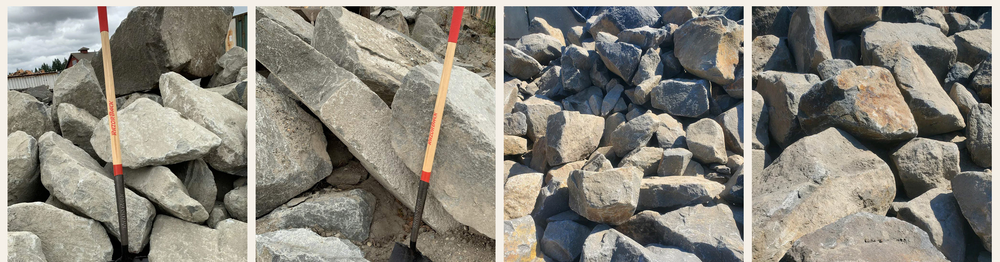
A well-placed landscape boulder does in five minutes of design what a year of planting cannot. It anchors a corner of the yard, marks an entry, holds down a slope, finishes a water feature, or just gives the eye somewhere to land. Unlike rockery (which is stacked into walls) or decorative rock (which is dumped as ground cover), landscape boulders are individual pieces selected and placed one at a time for their shape, weight, and presence.
This guide covers what landscape boulders are, the eight applications that actually work, how much they cost (real Harbor Soils delivered pricing), how to choose the right one, and how to place it so it looks like it was always there. Built for Pacific Northwest yards.
Quick answer: what is a landscape boulder?
A landscape boulder is a large natural stone (usually 200 lbs to several tons) selected for its individual shape and character, used as a single placed feature in a yard rather than as part of a wall. Harbor Soils stocks natural boulders at $91.99 per ton; a single residential-scale boulder typically runs $90 to $400 depending on size. The right placement, with the boulder partially buried so it looks like it grew from the ground, makes the difference between "rock dropped in yard" and "intentional landscape feature."
Size and weight: most feature boulders run 200 to 4,000+ lbs. Natural stone weighs about 160 lbs per cubic foot, so a 2-foot boulder is roughly 1,300 lbs and a 3-foot boulder about 4,300 lbs.
What is a landscape boulder?
The term "landscape boulder" gets used loosely. In a supply-yard context, it specifically means:
- Large. Typically 200 lbs to 4,000+ lbs. Anything smaller is usually called rockery (1-man) or decorative rock. Anything larger is special-order or shoreline-armoring grade.
- Individually selected. Not crushed to a uniform size. Each one is unique, with its own shape, color, texture, and "good side." Buying landscape boulders is closer to buying art than buying gravel.
- Placed, not stacked. A landscape boulder lives as a single feature, sometimes paired with one or two others in a composition. Walls and terracing call for rockery, which is stacked.
- Natural source. Most landscape boulders are sourced from riverbeds, glacial deposits, and construction-site excavations. They have rounded edges and weathered surfaces that distinguish them from freshly-quarried angular stone.
In our Gig Harbor yard, we stock Natural Boulders ($91.99/ton) that range from 200 lbs to several thousand pounds. The yard piles are walkable; the right way to buy a boulder is to come look at them in person and pick.
Best uses for landscape boulders
Entry markers and driveway accents
A pair of medium boulders (500-1,500 lb each) flanking a driveway entrance is the highest-impact landscape feature on most properties. Costs less than $300 in materials, takes a half-day to place, transforms how the house reads from the street. Common across Gig Harbor, Canterwood, and the bluffs above Wollochet Bay.
Garden focal points
A single substantial boulder (800-2,000 lb) anchors a bed of perennials, ornamental grasses, or low-maintenance natives. The eye lands on the boulder and uses it to organize the surrounding planting. Particularly effective in Japanese-inspired, Mediterranean, and modern minimalist designs.
Water features
Natural boulders are the standard accent at the base of a pondless waterfall, beside a stream, or at the corners of a formal pond. The irregular shapes and rough surfaces handle splash zones, provide habitat structure, and look like the water always flowed past them. Use one large boulder as the primary feature and two or three smaller ones as supporting cast.
Slope accent and erosion check
On a planted slope, a few well-placed boulders break up the visual continuity and create natural planting pockets in their lee. They also serve as informal erosion checks: the boulder slows water and traps soil and mulch behind it. Best on slopes between 15 and 30 percent (steeper slopes need engineered rockery or actual retaining walls, see our rockery walls guide).
Around fire-pit areas
A single large boulder beside a fire-pit area gives you a substantial visual anchor and an informal bench for one or two people. Stones over about 800 lbs have enough thermal mass that they stay cool to the touch even with a fire burning a few feet away. Pair with pea gravel as the surfacing material.
Garden borders (large-scale)
For a substantial property border or a planting-bed edge that needs to also serve as a casual sitting wall, individual boulders spaced 4-8 feet apart, partially embedded, give you both function and form. The boulders define the line without forming a hard wall; the open ground between is planted with low groundcover.
Property line markers
Where a property line crosses an open lawn or pasture, a single large boulder (1,500+ lb) marks the boundary in a way that posts, fences, and signs cannot match. Common on rural Kitsap and Pierce County properties where formal fencing would be out of character.
Lawn ornaments and conversation pieces
Sometimes a yard just needs a boulder. Placed in a substantial bed of decorative rock or moss, a large boulder with unusual shape or color works as pure sculpture. The Pacific Northwest's quarry and glacial inventory includes some genuinely strange and beautiful pieces; the right one becomes a focal point that visitors will comment on for decades.
Landscape boulder cost: what to expect
Boulders are priced by the ton at Harbor Soils. A 1,000-pound boulder is half a ton, so its material cost is half of the per-ton price. Real per-boulder costs at $91.99/ton for our Natural Boulders:
| Boulder size | Approx weight | Diameter (approx) | Material cost | Typical use |
|---|---|---|---|---|
| Small accent | 200-400 lb | 14-20″ | $9-$18 | Garden bed accent, water-feature support stone |
| Medium accent | 500-1,000 lb | 20-30″ | $23-$46 | Driveway flanker, large garden focal point |
| Large feature | 1,000-2,000 lb | 30-42″ | $46-$92 | Primary water-feature accent, entry boulder |
| Statement boulder | 2,000-4,000 lb | 42-60″ | $92-$184 | Property-line marker, lawn focal point, slope anchor |
| Premium / extra large | 4,000-8,000 lb | 60-84″ | $184-$368 | Major entrance feature, commercial / civic projects |
Add for delivery and placement: a small boulder you can roll into position yourself adds only the delivery fee. Anything over about 500 lbs needs equipment to position. Mini-excavator rental runs $300-$450/day; many landscape contractors will hand-place a few delivered boulders for $100-$300 in labor as a small job.
Total typical residential boulder project: $200-$800 in materials and delivery for a pair of entry markers or a feature composition.
How to choose a landscape boulder
Boulder shopping really does not translate to ordering by phone. The piece you actually want has a specific shape, a specific "good side," and a specific size that you can only judge in person. Come to our Gig Harbor yard at 11612 WA-302, walk the piles, and pick. We have a forklift to position and load your selections.
What to look for:
- The "good side." Most boulders have one face that is more interesting than the others (better color variation, more weathered texture, more dramatic shape). That side faces the viewer in the final placement. Look at every stone from multiple angles before deciding.
- Stable base. A boulder needs a flat-ish bottom or a clear "down" orientation. Stones that have to balance on a point look unintentional and tend to tip during placement.
- Scale to your space. Big yards need bigger boulders to register; a 300-lb stone disappears in a 10,000 sq ft lawn. Small yards are overwhelmed by 3,000-lb statement stones. As a rule of thumb, the boulder should be visible from your main viewing point but not dominate everything else.
- Color and texture vs your house. Gray-blue basalt reads modern. Brown-tinted granite reads traditional. Mossy older stones read cottage / natural. Match (or deliberately contrast) the architecture.
- Composition pieces. If you are placing two or three boulders together, choose them as a group so the sizes and shapes complement. Avoid two stones of nearly the same size; vary them clearly so the eye reads them as related but distinct.
Boulder sizes and weights (a practical guide)
Boulders are sold by the ton, but you live with them as individual pieces. Here is the rough conversion between weight, dimension, and what you can do with each size.
| Weight | Approx dimension | What you need to move it |
|---|---|---|
| 200-400 lb | 14-20 in | 2 people, pry bars, hand truck. Slow but possible. |
| 500-1,000 lb | 20-30 in | Mini-excavator, skid steer with grapple, or hand-truck-and-ramp. |
| 1,000-2,000 lb | 30-42 in | Mini-excavator with thumb, or compact wheel loader. Not hand-movable. |
| 2,000-4,000 lb | 42-60 in | Full-size excavator or wheel loader. Plan delivery placement carefully. |
| 4,000+ lb | 60+ in | Significant equipment. Usually placed by delivery driver from truck-mounted boom or crane. |
Quick rule: 1 cubic foot of natural stone weighs roughly 160 lbs. A boulder that is 30 inches in every dimension is about 2.5 cubic feet of stone, weighing roughly 400 lbs. A 3-foot-cube boulder is 27 cubic feet, weighing about 2.5 tons.
How to place a landscape boulder so it looks right
The most common landscape boulder mistake is setting a stone on top of the ground instead of partially burying it. A boulder sitting on bare earth looks dropped. A boulder with a third of its mass below grade looks like it grew there.
Step 1: Mark and dig the placement pocket
Dig a hole 1/3 to 1/4 the height of the boulder, slightly wider than the boulder's base. For a 30-inch-tall stone, dig 8-10 inches deep. Square the bottom of the pit; the boulder needs to rest level.
Step 2: Set a leveling pad
Place 2-3 inches of compacted 3/4 minus gravel in the bottom of the pit. The gravel pad lets you level the stone without it settling unevenly over years. Skip the pad and the boulder slowly tilts as the soil beneath it compresses.
Step 3: Position the boulder with the good side out
This is where having seen the boulder in the yard pays off. Set it with the most interesting face oriented toward the main viewing point (deck, front walk, kitchen window). Use a pry bar or the excavator bucket to fine-tune the rotation; once it is in the pit, small adjustments are still possible.
Step 4: Backfill and tamp
Fill the gap between the boulder and the pit walls with native soil or 3/4 minus, tamping firmly as you go. The fill locks the boulder in place and prevents it from rocking. For boulders on slopes, use minus rather than soil; minus locks better against gravity over time.
Step 5: Naturalize the base
Plant low-growing groundcover (kinnikinnick, low Oregon grape, creeping thyme) or set pea gravel around the boulder's base so the soil-to-stone transition is not a sharp line. This is what makes the boulder read as part of the landscape rather than as a placed object.
Three common landscape boulder mistakes
- Too small for the space. A 300-lb boulder in front of a two-story house disappears. As a rule, the boulder's largest dimension should be at least 1/4 the height of the nearest vertical surface (house wall, fence, tall tree). Most homeowners underspend on size; you almost never regret going bigger.
- Setting it on top of the ground. A boulder needs to be partially buried to look intentional. Plan to bury 1/4 to 1/3 of the height. This usually means the boulder you bought looks shorter than you expected once it is placed; that is correct.
- Even number, equal sizes. Multiple boulders look best in odd-numbered groupings (1, 3, 5) with deliberate size variation. Two boulders the same size next to each other read as a paired set and lose the natural quality. Three boulders of clearly different sizes read as a composition.
Landscape boulders vs rockery vs decorative rock
- Landscape boulders are individual large stones (200 lb to several tons) placed as features. Selected for shape and character. $91.99/ton at Harbor Soils. Use when you want a single substantial visual anchor.
- Rockery is sorted stone (1-man, 2-man, 3-man) used to build dry-stacked walls. Selected for stackability and flat faces. $83.99-$107.99/ton depending on stone type. Use when you need to retain a slope or build a vertical surface. Browse our rockery rock collection or see our rockery walls guide for the full breakdown.
- Decorative rock is smaller, color-selected stone (typically 1-3 inches) used as ground cover. Sold by the yard. Use as the surfacing material around boulders and in beds. Browse our decorative rocks collection.
Most substantial landscape projects use all three: a landscape boulder or two as focal points, rockery for any walls or terracing, decorative rock or pea gravel as the ground-cover surface.
Landscape boulder delivery in Gig Harbor and Kitsap County
We deliver landscape boulders throughout Gig Harbor (zip codes 98329, 98332, 98335, 98349), Port Orchard, Bremerton, Silverdale, Poulsbo, Bainbridge Island, Olalla, Purdy, Fox Island, and Key Peninsula. Delivery considerations specific to boulders:
- Visit the yard first. Boulder shopping needs to happen in person. Come pick the specific stones you want, then we coordinate delivery.
- Drop placement matters. For boulders over about 800 lbs, we drop in the closest stable, accessible location to the final placement. Moving a 1-ton boulder across a yard is a separate operation; minimizing the move saves time and money.
- Equipment access. The truck needs paved or graveled access. For final placement, you will need a mini-excavator or skid steer (rental $300-$450/day) for anything over about 500 lbs.
- Contractor coordination. Many local landscape contractors will hand-place delivered boulders as a small job ($100-$300). Ask us for recommendations.
For boulder selection or to coordinate delivery, visit the yard at 11612 WA-302 or call 253-857-5125. We have a forklift to load specific pieces you pick.
Harbor Soils
11612 WA-302, Gig Harbor, WA 98329
253-857-5125 · [email protected]
Frequently asked questions
What is a landscape boulder?
A landscape boulder is a large natural stone (typically 200 lbs to 4,000+ lbs) used as an individual placed feature in a yard, garden, or landscape. Unlike rockery (which is stacked into walls) or decorative rock (which is dumped as ground cover), landscape boulders are selected and placed one at a time for their shape, weight, and character.
How much do landscape boulders cost?
At Harbor Soils, Natural Boulders are $91.99 per ton. A 500-lb boulder costs about $23 in material; a 1,000-lb boulder costs $46; a 2,000-lb statement piece costs about $92. Add delivery (based on distance from our Gig Harbor yard) and placement equipment if the boulder is over about 500 lbs.
How much does a landscape boulder weigh?
Natural stone weighs roughly 160 lbs per cubic foot. A boulder 24 inches in every dimension weighs about 1,280 lbs (8 cubic feet). A 3-foot-cube boulder weighs about 4,300 lbs. Most "feature" boulders for residential yards are in the 500-2,000 lb range, between 20 and 36 inches across.
How do I move a landscape boulder?
For boulders under 400 lbs, two people with pry bars and a hand truck can do it slowly. 500-1,000 lb stones need a mini-excavator, skid steer with grapple, or hand-truck-and-ramp setup. Anything over 1,000 lbs requires a mini-excavator with thumb attachment or a compact wheel loader. For 2,000+ lb stones, plan delivery placement carefully because moving them again is a significant operation.
How big of a landscape boulder do I need?
Match the boulder to the space. For garden bed accents, 200-500 lbs is usually right. For driveway flankers or property entry markers, 500-1,500 lbs reads better. For lawn focal points or property-line markers visible from 50+ feet, 1,500-4,000 lbs. As a rule, the boulder's largest dimension should be at least 1/4 the height of the nearest vertical surface (house wall, fence, tall tree).
How do I place a landscape boulder so it looks natural?
Bury 1/4 to 1/3 of the boulder's height in a leveling pad of compacted 3/4 minus gravel. The boulder needs to look like it grew from the ground, not like it was dropped on top of it. Set the "good side" (most interesting face) toward the main viewing point. Naturalize the base with low groundcover or pea gravel so the soil-to-stone transition is not a sharp line.
Can I have landscape boulders delivered?
Yes. We deliver throughout Gig Harbor, Port Orchard, Bremerton, Silverdale, Poulsbo, Bainbridge Island, Olalla, Purdy, Fox Island, and Key Peninsula. For boulder selection, visit our yard at 11612 WA-302 in Gig Harbor to pick the specific stones in person; ordering boulders by phone usually results in pieces that do not match what you had in mind.
What is the difference between a landscape boulder and rockery?
Landscape boulders are individual stones placed as features. Rockery is sorted stone (1-man, 2-man, 3-man sizes) used to build dry-stacked walls. Boulders are selected for individual shape and character; rockery is selected for stackability and consistent sizes. Boulders run $91.99/ton; rockery runs $83.99-$107.99/ton depending on stone type. See our rockery walls guide for the full breakdown of wall-building options.
Where can I buy landscape boulders in Gig Harbor or Kitsap County?
Harbor Soils stocks natural boulders at our Gig Harbor yard (11612 WA-302). You walk the piles, pick the specific stones you want, and we coordinate delivery throughout Kitsap and Pierce County. Boulder shopping is one of the only landscape-material purchases that really does not translate to online ordering, so come out and look.
Do I need a permit to place a landscape boulder?
For most residential boulder placement, no permit is required. If you are placing boulders within a critical-areas overlay (steep slope, shoreline, wetland buffer) or as part of shoreline armoring, county planning rules may apply. For non-shoreline residential yards, you can place boulders freely.